Anyone shopping for the best rolling sewing carts is usually trying to solve the same problem: keep a sewing setup organized without letting it sprawl across the whole room. A good cart can turn a cluttered corner into a usable sewing station, make tools easier to reach, and save time when a project is in progress. The challenge is that “rolling” can mean several different things. Some options are really portable cases for sewing machines, while others are storage carts or compact sewing tables built around wheels. Choosing the wrong style is one of the most common mistakes buyers make.
What matters most depends on how you sew. If you travel with your machine, portability and protection matter more than shelf space. If you sew at home, a cart with drawers, a tabletop, or a thread organizer may be the smarter fit. Shoppers also tend to overlook size, wheel quality, and how much weight the cart can realistically carry. The strongest choices balance mobility with stability, because a cart that rolls well but wobbles under load is frustrating in daily use. The top overall pick in this roundup stands out for being practical, sturdy, and easy to adapt to different rooms and routines.
Different buyers will prioritize different things, from compact storage to machine transport to a more permanent sewing station. That is why the best choice is not always the biggest cart or the one with the most features. It is the one that fits your space, your machine, and the way you actually work.
If you are short on time, the comparison table below gives a quick snapshot of the leading options. Click any product name to jump to its full review.
Quick Answer
The best rolling sewing carts in this guide cover a wide range of needs, from travel-ready machine cases to compact storage carts and full sewing workstations. For most home sewers, the Giantex Folding Sewing Table is the most complete option because it combines workspace, storage, mobility, and a built-in charging station. If your priority is simple organization on a budget, the YASONIC 3 Tier Rolling Cart and DTK 3 Tier Metal Utility Rolling Cart offer strong value. For travelers, the CAB55 Rolling Sewing Machine Case and SLINRKE Sewing Machine Case are better suited to protecting a machine on the move. And if you need a fuller craft station, the Sewing Table with 60 Spools Thread Holder is the most specialized pick here.
The table below compares the nine best options at a glance before the deeper reviews begin.
Best Rolling Sewing Carts Comparison Table
| Product | Best For | Main Strength | Key Feature |
|---|---|---|---|
| 3 Tier Heavy Duty White Metal Rolling Cart | Budget-friendly general craft storage | Simple, sturdy, and versatile | 3-tier metal baskets with lockable wheels |
| SLINRKE Sewing Machine Case With Wheels | Traveling with a standard sewing machine | Portable protection | Padded case with multiple pockets |
| Sewing Table With 60 Spools Thread Holder | Thread-heavy sewing rooms | Dedicated sewing organization | Thread holder plus fabric drawers |
| CAB55 XXL 23-Inch Rolling Sewing Machine Case | Oversized and professional machines | Maximum protection | Rigid base and 4-wheel system |
| Giantex Folding Sewing Table | Small rooms and multipurpose spaces | Workspace plus storage | Foldable design with charging station |
| CAB55 Rolling Sewing Machine Case | Carry-on friendly transport | Portable and protective | Detachable board with 2-wheel base |
| YASONIC 3 Tier Rolling Cart | Low-cost craft and supply storage | Strong value | Metal baskets, cups, and hooks |
| ALVOROG Rolling Cart With Drawer And Wood Table Top | People who want drawers and tabletop use | Mixed storage style | Pegboards, drawers, and tabletop |
| DTK 3 Tier Metal Utility Rolling Cart | Flexible sewing and craft use | Useful hybrid storage | Table top, side bag, and hooks |
For readers who want more detail, the reviews below explain how each cart differs in real-world use and which kind of sewer it suits best.
1. Best Overall: 3 Tier Heavy Duty White Metal Rolling Cart

This rolling cart earns the top spot because it gets the basics right. It is not trying to be a full sewing cabinet or a machine carrier. Instead, it offers the kind of straightforward storage most sewing rooms actually need. The three metal baskets give you enough room for fabric bundles, notions, tools, and small project bins, while the hanging cups and hooks add just enough flexibility for scissors, tape, rulers, or thread snips. For a lot of crafters, that combination is more useful than a cart packed with gimmicks.
The lockable wheels are another practical advantage. In a sewing room, mobility matters, but so does stability when you are reaching for supplies or setting down a project. The powder-coated steel frame should hold up well for everyday use, and the mesh basket design helps keep supplies aired out rather than trapped in a closed, dusty space. It is also one of the easier products in this roundup to repurpose if your sewing needs change over time, since it can serve as a general craft cart, a classroom organizer, or a utility storage piece elsewhere in the house.
Pros
- Three-tier layout gives you flexible storage without taking up much floor space.
- Lockable wheels make it easier to keep the cart steady during use.
- Hooks and cups add handy storage for small sewing tools.
- Metal construction should be more durable than many lightweight plastic alternatives.
- Works well as a general-purpose cart if your craft setup changes later.
Cons
- It is not a dedicated sewing station, so you do not get a work surface.
- Open baskets mean smaller items may need bins or pouches to stay organized.
- Buyers looking for a machine carrier should look elsewhere.
This is the best fit for sewers who want simple, dependable storage rather than a full workstation. It is especially appealing if you keep tools, fabric, and WIP supplies in one area and want a cart that rolls easily between rooms. If you need drawers, a top surface, or machine transport, another model will be more specialized. But for pure everyday utility, this one is hard to beat.
To buy this product, click here.
2. Best For Travel: SLINRKE Sewing Machine Case With Wheels

For anyone who takes a machine to classes, retreats, or sewing groups, this case makes a lot of sense. It is built around portability first, which means the most important features are the padded construction, wheeled base, and multiple carrying options. The main compartment is sized for many standard sewing machines, and the surrounding pockets give you space for foot controls, cords, and the accessories that usually end up loose in a tote bag. That makes day-to-day travel easier and reduces the chance of forgetting something important.
The tradeoff is that this is a carrier, not a cart for active workspace storage. Buyers who want a sewing room organizer will likely find it too specialized. But if you need to move your machine without exposing it to bumps, scratches, or dust, the case format is a smart choice. The aluminum frame and heavy-duty nylon exterior should also be reassuring for frequent use. It is a particularly good option for beginners who want a simple way to transport a standard machine without investing in a larger or heavier case.
Pros
- Well suited to transporting a standard sewing machine safely.
- Padded construction helps protect against bumps and scratches.
- Multiple pockets keep accessories more organized than a basic tote.
- Three carry options add convenience for stairs, travel, and quick trips.
- Lightweight enough to be practical for classes and meetups.
Cons
- Not useful as a stationary storage cart.
- May be too compact for larger machines or bulkier accessory kits.
- Two-wheel design is good for travel but not as versatile as a true rolling workstation.
This is a sensible pick if your sewing life happens outside the home as much as inside it. It is less attractive for people who need room to store thread, fabric, and tools beside the machine. But for transport-focused buyers, it solves a very specific problem well and avoids unnecessary bulk.
To buy this product, click here.
3. Best Sewing Workstation: Sewing Table With 60 Spools Thread Holder

This model is the most specialized option in the roundup, and that is exactly why it stands out. Instead of just giving you shelves, it creates a clear place for a machine, thread storage, and smaller sewing essentials. The built-in 60-spool holder is the headline feature, but the three fabric drawers and hooks make the whole unit feel more complete. For sewists who work on multiple projects at once, being able to see and sort thread colors at a glance is a real advantage.
Its mobility is also more useful than it may first appear. Universal wheels let you move the cart when you need to rearrange the room, and the brakes keep it steady while you sew. The metal and MDF build should feel more substantial than lightweight utility carts, and the 200-pound load rating suggests it is intended for serious use rather than light decorative storage. The downside is that this is a purpose-built craft station, so it is less adaptable than open carts if you want something to use in multiple rooms for non-sewing tasks. Still, for a dedicated sewing space, it is one of the strongest all-in-one choices here.
Pros
- Built for actual sewing workflow, not just storage.
- 60-spool thread holder is especially useful for frequent sewists.
- Drawers and hooks improve small-item organization.
- Braked wheels make it easier to keep the cart stable while working.
- Feels more like a proper workstation than a general utility cart.
Cons
- Less flexible if you need a cart for non-sewing uses.
- More specialized than a basic rolling cart.
- Assembly and placement will matter more because of its workstation layout.
If your sewing room is cluttered with spools, tools, and fabric supplies, this is the kind of cart that can genuinely improve the space. It is not the best choice for someone who needs portability above all else, but it is excellent for people who want a compact, organized workstation in one place.
To buy this product, click here.
4. Best Premium: CAB55 XXL 23-Inch Rolling Sewing Machine Case

This is the choice for people who need serious protection for a serious machine. Oversized embroidery and heavy-duty sewing machines can be awkward to transport, and standard cases often feel like a compromise. The CAB55 XXL tries to solve that problem with a larger interior, a reinforced support board, and a four-wheel system that is designed to keep weight balanced more safely than a basic two-wheel carrier. That matters when the machine itself is expensive and not easy to replace.
The storage pockets are also more relevant here than they first seem. Professional or semi-professional sewists often travel with hoops, pedals, thread, and machine-specific accessories, and those items need to stay together. The foldable design is a thoughtful touch, because the case can be stored more easily when it is not in use. The obvious limitation is cost, plus the fact that this product makes sense only if you actually need the size and support. For a standard machine, it may be more case than necessary. But for oversized equipment, the added structure and stability can be worth it.
Pros
- Designed for oversized and professional sewing machines.
- Rigid support board helps reduce sagging under heavy loads.
- Four-wheel setup should improve stability and steering.
- Generous pockets help organize larger accessories and project pieces.
- Foldable design makes storage easier than you might expect from a large case.
Cons
- More expensive than standard machine cases.
- Likely unnecessary for smaller, lightweight machines.
- Bulkier than simpler transport bags.
Buy this if your machine is large, heavy, or especially valuable. It is the strongest choice in the group for protective transport, and the best option for quilters, instructors, or traveling sewists with oversized gear. If you do not need the extra size, you may be better served by a smaller and cheaper case.
To buy this product, click here.
5. Best For Small Spaces: Giantex Folding Sewing Table With Charging Station

Small-space sewers often have to choose between a usable work surface and a room that still feels livable. This folding sewing table is built around that problem. Expanded, it gives you a sizable tabletop, storage bins, and an open shelf that can hold fabric, supplies, or a compact iron. Folded down, it occupies less room and becomes much easier to tuck into an apartment, studio, or shared household space. That flexibility is the main reason it deserves attention.
The charging station is another feature that makes practical sense rather than feeling ornamental. Sewing rooms tend to accumulate cords for lights, machines, irons, and small gadgets, so built-in outlets and USB connections can reduce clutter. Five caster wheels add mobility, and the locking wheels help stabilize the unit once you are ready to sew. The downside is that, like most foldable furniture, it is a compromise. You are getting convenience and versatility, not the heaviest-duty cabinet on the market. Still, for many home sewists, especially beginners or apartment dwellers, that tradeoff is worth it.
Pros
- Folds down when you do not need a full sewing station.
- Built-in charging options are genuinely convenient.
- Storage bins and shelf help keep supplies organized.
- Lockable wheels add stability during use.
- Useful as a sewing table, craft desk, or general utility cabinet.
Cons
- Not as rugged as a fixed cabinet-style workstation.
- Assembly and folding hardware add complexity.
- May be overkill if you only need basic storage.
This is a strong pick for sewists who need a real work surface but do not have a dedicated sewing room. It is especially compelling if you value tidy storage and a desk that can serve multiple roles. If you mostly need portable storage for tools, a simpler cart may be easier to live with.
To buy this product, click here.
6. Best For Carry-On Travel: CAB55 Rolling Sewing Machine Case

This CAB55 case is aimed at practical travel, especially for standard-size machines that need more protection than a tote but less bulk than a large upright cart. The removable wooden board is a useful detail because it gives the case a firmer base for heavier machines and helps everything stay more level while rolling. For sewists who travel to classes or workshops, that kind of support can make the difference between a convenient case and a frustrating one.
The layout also shows that this case is meant to handle more than the machine itself. With multiple pockets and spool storage, it gives accessories a place to live instead of leaving them floating loose in a bag. The two-wheel design keeps it simple, and the handle plus shoulder strap add flexibility when stairs or tight spaces come into play. It is not the most spacious choice in the roundup, and larger machines may feel cramped, but it is one of the better options if you want a travel-friendly case that stays organized and folds away when not in use.
Pros
- Travel-friendly size for many standard machines.
- Removable hard base adds useful support.
- Pockets and spool storage help organize accessories.
- Handle and shoulder strap add flexibility when lifting is required.
- Designed to be easier to store than larger rolling cases.
Cons
- Not ideal for larger or oversized sewing machines.
- Two-wheel design is less stable than four-wheel options for some users.
- Storage is practical, but not especially generous.
If you need a balanced travel case for a normal sewing machine, this is a thoughtful pick. It is a particularly good option for people who want something sturdier than a soft tote but do not need the XXL format of the premium CAB55 model. Buyers with larger machines should probably move up to the oversized version instead.
To buy this product, click here.
7. Best Budget: YASONIC 3 Tier Rolling Cart

This is one of the strongest low-cost choices in the roundup because it offers the features most sewists actually use. The three metal baskets create straightforward storage for fabric, notions, or project supplies, while the hanging cups and hooks help manage smaller items that tend to get lost in bigger bins. That mix makes the cart feel more useful than a plain shelf unit, especially in small craft spaces where every inch matters.
Durability is also a selling point here. The all-metal build and the advertised load capacity suggest that this cart is meant for regular use rather than light decoration. The smooth-rolling wheels and scratch-resistant finish are helpful details if you plan to move it often or use it in a room with hard floors. Of course, this is still a basic utility cart, so it will not replace a proper sewing cabinet or machine carrier. But for the price tier, it offers a lot of practical value and is easy to recommend to beginners, students, or anyone setting up a temporary sewing corner.
Pros
- Excellent value for basic sewing and craft storage.
- All-metal construction should hold up better than flimsy alternatives.
- Hooks and cups add useful small-item storage.
- Easy to repurpose for other household tasks later.
- Wheels and compact footprint make it friendly for smaller rooms.
Cons
- Open baskets do not protect supplies from dust.
- Not a workstation or sewing machine carrier.
- Assembly quality may matter more at this price level.
Choose this if you want a straightforward rolling organizer without paying for sewing-specific extras. It is best for storage-minded buyers who want to keep tools and supplies close at hand. If you need drawers, a tabletop, or a place for your machine, step up to a more specialized cart.
To buy this product, click here.
8. Best For Organization: ALVOROG Rolling Cart With Drawer And Wood Table Top

Some sewing carts are all about open storage, but this one is better for people who like a place for everything. The combination of a wood tabletop, two drawers, pegboards, hanging baskets, and hooks makes it unusually versatile. You can use the top as a small work or staging surface, keep thread or tools in the drawers, and rely on the side storage for scissors, rulers, and small accessories. That layered organization can be especially helpful for crafters who are tired of loose notions scattered across a table.
The compact size is another reason it belongs on this list. It is easier to place in a corner or beside a desk than a larger cart, yet it still delivers more storage flexibility than many basic 3-tier models. The mesh baskets and lockable wheels add utility, and the overall look is a bit more polished than a purely industrial cart. The tradeoff is that it still cannot replace a larger workstation if you need room for cutting fabric or holding a full-size machine. But as a compact organizer with smart details, it does a lot well.
Pros
- Combines drawers, baskets, hooks, and a tabletop in one unit.
- Pegboards help keep small tools visible and easy to reach.
- Compact enough for smaller rooms and tight corners.
- Looks more finished than a bare utility cart.
- Good balance of hidden and open storage.
Cons
- Not intended as a full sewing workstation.
- Smaller footprint means less room for bulky supplies.
- More pieces can mean more time during assembly.
This is a strong choice for buyers who value order and want a cart that keeps visual clutter down. It is especially useful in shared rooms, craft nooks, or bedroom sewing spaces where appearance matters as much as practicality. If you want a minimal cart that only holds bins, this may feel more complex than necessary.
To buy this product, click here.
9. Best Versatile: DTK 3 Tier Metal Utility Rolling Cart
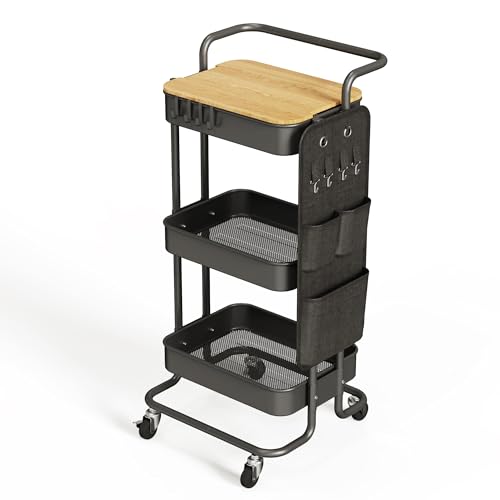
The DTK cart is a good example of a product that does a lot of things adequately, which can be exactly what some buyers need. The three mesh trays provide clear storage for supplies, and the removable tabletop is useful if you want to keep dust off a project or create a small flat surface for quick tasks. The side storage bag adds another layer of convenience for smaller items that tend to vanish in open carts. That combination makes this cart more adaptable than a plain three-tier organizer.
For sewing and crafts, versatility matters because your workflow may change from day to day. Some sessions are about sorting fabric, some are about holding tools, and some are just about having a mobile place to set things down. This cart handles those roles well enough, especially in smaller spaces. It is not the most refined-looking model here, and it is not a machine carrier or a true workstation, but it makes up for that with broad usefulness. If you want one cart that can shift between craft room, office, and general home storage, it is a sensible choice.
Pros
- Tabletop, trays, and side bag create flexible storage options.
- Good fit for sewing rooms that also need general utility.
- Lockable wheels add security once the cart is in position.
- Useful in narrow spaces where a larger cabinet would not fit.
- Open layout keeps supplies visible and easy to access.
Cons
- Not as specialized as a true sewing cart or machine case.
- Side bag storage may appeal less to buyers who want a cleaner look.
- Open metal trays can require extra bins for tiny notions.
Buy this if you need a practical rolling helper that can move between tasks without much fuss. It is a particularly good value for mixed-use rooms, though dedicated sewers may prefer a model with more purpose-built storage or a stronger work surface.
To buy this product, click here.
How We Chose
To narrow this list, we focused on rolling sewing carts that serve a real purpose for everyday sewing and crafting, not just products that happen to have wheels. That meant comparing storage layout, portability, stability, size, and whether each item clearly fits one of the main use cases shoppers have in mind: machine transport, compact sewing-room organization, or a mobile workspace. We also gave extra weight to practical details such as lockable wheels, pockets, thread storage, and build materials, because those features tend to matter more over time than flashy extras.
Another priority was variety. Sewing is not one-size-fits-all, so this roundup includes both travel cases and home storage carts. That helps readers match a product to the way they actually sew instead of forcing every buyer into the same format. We also looked for products that offered a realistic balance of value and function. In other words, each recommendation had to make sense at its price tier and show a clear reason for being in the guide. The result is a list that covers a range of spaces, budgets, and sewing habits without drifting into gimmicky picks.
Buying Guide
Choosing the best rolling sewing carts starts with deciding what problem you want the cart to solve. If you need to move a sewing machine safely, look for a padded case with a stable base and enough room for cords, pedals, and accessories. If you need to keep a sewing room organized, an open utility cart or a cart with drawers may make more sense. And if you want a real sewing station, you will probably be happier with a cart or table that includes a work surface, thread storage, and lockable wheels. The style matters because a cart that looks useful online can still be awkward if it does not match your actual routine.
Size is the first detail to check. Measure your machine or your storage needs before you buy, especially if you are considering a machine case. Standard-sized models often work for many home machines, but larger embroidery machines or heavy-duty models need more room and stronger support. For storage carts, think about how much floor space you have and whether you need a narrow profile to fit beside a desk, in a closet, or between furniture. A compact cart that fits well is usually more useful than a larger one that gets in the way.
Wheel quality also matters more than many shoppers expect. Smooth wheels make a cart easier to reposition, but lockable wheels add stability when you are working. If you plan to roll the cart across carpet, hardwood, or tile, make sure the wheel design seems suited to your floor type. For machine carriers, a two-wheel format can be fine for travel, while a four-wheel setup can feel steadier for heavier loads. In a sewing room, stability often matters just as much as mobility, because a cart that shifts while you reach for supplies quickly becomes annoying.
Storage style should match your tools. Open baskets work well for fabric, bins, and larger items you need to see quickly. Drawers are better for notions, presser feet, and smaller accessories that can get lost. Hooks and side cups are useful for scissors, thread snips, tape measures, and other frequently used tools. A top shelf or tabletop can be especially helpful if you use the cart as a staging area. The best choice is usually the one that mirrors how you already organize your sewing supplies rather than forcing a new system on you.
Materials tell you a lot about durability. Metal carts are usually better for long-term sturdiness and heavier loads, while padded fabric cases are the right choice for travel protection. MDF or wood-topped carts can feel more like furniture, but they may be less forgiving if you want something very lightweight. If your cart will live in a busy sewing room, look for finishes that are easy to wipe down and materials that can handle frequent use. The goal is not just to buy something attractive, but to buy something you will still be happy with after a year of project clutter and movement.
Finally, think honestly about your sewing habits. If you sew once in a while, you probably do not need the most elaborate workstation. If you sew several times a week, better organization may save time and make the hobby more enjoyable. If you attend classes or retreats, portability and protection should outrank storage capacity. Matching the cart to your actual routine is the simplest way to avoid buyer’s regret.
Best Rolling Sewing Carts FAQ
What Is The Difference Between A Rolling Sewing Cart And A Sewing Machine Case?
A rolling sewing cart is usually a storage or workspace solution for a sewing room. A sewing machine case is built to move the machine safely from place to place. If you need to organize thread, fabric, and tools at home, choose a cart. If you need to transport your machine, choose a padded case with wheels and internal support.
Do I Need Lockable Wheels On A Sewing Cart?
Lockable wheels are not mandatory, but they are very helpful if you sew at the cart itself. They keep the unit from rolling while you are reaching for supplies or leaning on it. For a cart that stays parked most of the time, locks are a useful stability feature rather than a luxury.
Are Metal Rolling Carts Better Than Plastic Ones For Sewing?
Metal carts are usually sturdier and better suited to heavier supplies. Plastic carts can be lighter and more affordable, but they often feel less substantial. If you store fabric, tools, and bins, metal is usually the safer bet. If you only need a light-duty organizer, plastic can still work.
What Size Rolling Sewing Cart Should I Buy?
The right size depends on whether you are storing a machine or supplies. For machine cases, measure the machine carefully and leave room for padding. For carts, check the footprint of your room and decide how much storage you need. In tight spaces, a narrower cart with vertical storage is often more practical than a wide one.
Can A Rolling Sewing Cart Replace A Sewing Table?
Sometimes, but not always. A storage cart can make a sewing space more efficient, while a sewing table gives you a dedicated work surface. If you need cutting space, machine support, or a place to leave projects in progress, a table-style unit is usually the better choice. If you just need organized storage, a cart may be enough.
What Features Matter Most For Beginner Sewists?
Beginners usually benefit most from simple storage, easy mobility, and a cart that keeps basic tools within reach. You do not need the most advanced workstation to start. A compact cart or a simple machine case can be more helpful than a large setup that takes a lot of time to assemble and organize.
How Do I Keep A Rolling Sewing Cart From Becoming Cluttered?
The best approach is to assign each level or drawer a purpose. Keep frequently used tools on top, reserve lower shelves for fabric or project bins, and use cups or hooks for small items. If possible, add small containers so loose notions do not spread across the whole cart. A good cart works best when it supports a system rather than becoming the system.
Final Verdict
The strongest all-around pick in this roundup is the 3 Tier Heavy Duty White Metal Rolling Cart because it delivers exactly what many sewing rooms need, which is practical, dependable storage without unnecessary complexity. It is versatile, stable, and easy to adapt, making it a good fit for sewists who want a cart that works for fabric, notions, and everyday project overflow. If you need a true workstation, the Giantex Folding Sewing Table With Charging Station is the most compelling home setup, while the Sewing Table With 60 Spools Thread Holder is the most specialized choice for organization-heavy craft spaces. For travel, the two CAB55 cases and the SLINRKE case stand out for machine transport and protection.
The best choice ultimately depends on how you sew. If you need portability, focus on padded cases and support boards. If you sew in one place, prioritize storage layout, lockable wheels, and a surface that helps keep your workflow tidy. And if your craft space is shared or small, a compact rolling cart with useful side storage may be the smartest buy of all. In this category, the right cart is the one that makes your sewing life easier every time you use it, not the one with the most features on paper.
Leave a Reply