
Electrical safety problems often hide in plain sight, and that is exactly why so many homeowners look for the best outlet testers for home inspection. A simple plug-in tester can reveal reversed polarity, open grounds, and other wiring issues that are easy to miss until a fixture fails, a breaker trips, or a renovation uncovers a bigger problem. For anyone checking an older home, verifying freshly replaced receptacles, or making sure bathroom and kitchen GFCI protection is actually working, this is one of the most practical tools you can own.
The mistake many buyers make is assuming every outlet tester does the same thing. Some are bare-bones indicators built for quick pass-fail checks. Others add LCD readouts, GFCI trip-time reporting, or even breaker-finding and non-contact voltage detection. The right choice depends on how deeply you want to inspect, how often you will use the tool, and whether you value simplicity or extra diagnostics. For most homeowners, the top recommendation is a straightforward tester that is fast, durable, and easy to read. More advanced users may want a model that gives more context than just a light pattern.
If you are short on time, the quick answer and comparison table below offer a fast way to compare the main options before diving into the full reviews.
Quick Answer
If you want the simplest answer, the Klein Tools RT210 is the best all-around choice for most home inspection tasks. It is easy to use, works with standard and GFCI outlets, and gives fast, reliable results without adding complexity. Buyers who want a low-cost backup or a basic tester for occasional checks should look at the Klein Tools RT110 or the Power Gear Receptacle Tester. If you want clearer readings and a more diagnostic approach, the Klein Tools RT250 is the strongest upgrade. For more advanced inspection work, the Klein Tools RT310 and RT390 go well beyond a basic plug tester.
Best Outlet Testers For Home Inspection Comparison Table
| Product | Best For | Main Strength | Key Feature |
|---|---|---|---|
| Klein Tools RT210 | Most homeowners | Fast, reliable everyday testing | GFCI and standard outlet checks |
| Klein Tools RT250 | Buyers who want more detail | LCD readout and trip-time info | Open neutral and open ground detection |
| Klein Tools RT110 | Budget-conscious shoppers | Simple, trustworthy indicator lights | Basic wiring fault detection |
| Outlet Tester With GFCI Check | Value seekers | Compact, easy-to-read design | Multiple light-sequence checks |
| Klein Tools 80025 Kit | General DIY users | Two useful tools in one kit | Outlet tester plus non-contact voltage pen |
| Klein Tools RT390 | Advanced inspection work | Deep diagnostic capability | GFCI, AFCI, and load testing |
| Sperry Instruments GFI6302 | Rough jobsite handling | Durable housing and strong protection | Clear neon light indication |
| Klein Tools RT310 | Homes with AFCI protection | Tests AFCI and GFCI outlets | Flexible cord for awkward locations |
| Klein Tools NCVT1PKIT | Extra safety awareness | Voltage pen plus outlet tester | Non-contact detection for broader checks |
For a closer look at each option, the reviews below explain how these testers differ and which type of buyer each one suits best.
1. Best Overall: Klein Tools RT210
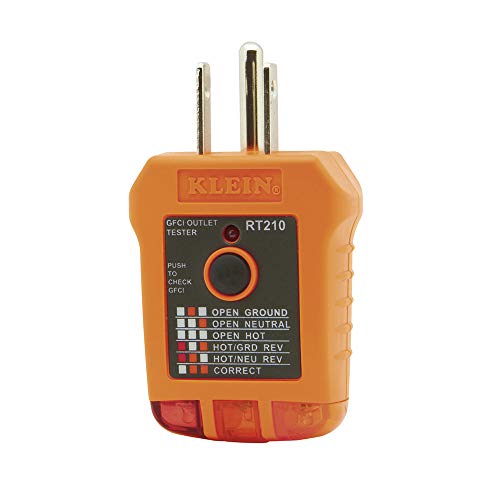
The Klein Tools RT210 is the kind of outlet tester most homeowners should start with because it does the essential job well and keeps the process simple. It checks standard and GFCI receptacles, identifies common wiring problems, and gives quick visual feedback without asking the user to interpret a screen or manage extra settings. That matters in home inspection work, where speed and clarity usually beat sophistication. If you are walking room to room in an older house, checking a remodel, or confirming that a bathroom GFCI trips properly, the RT210 delivers the kind of immediate readout people actually use.
Its other advantage is confidence. Klein Tools has a strong reputation in electrical hand tools, and this model feels built for repeated use rather than occasional novelty. The drop resistance and wide operating temperature range are not flashy features, but they do help if the tester gets tossed into a tool bag, used in a garage, or carried around a property during a pre-purchase walkthrough. The RT210 is not the most feature-rich option here, and buyers who want voltage numbers or detailed diagnostics should look elsewhere. Still, for most home inspection scenarios, it strikes the best balance of accuracy, durability, and everyday convenience.
Pros
- Very easy to use, even for first-time homeowners.
- Works with both standard and GFCI outlets.
- Clear visual feedback keeps testing fast.
- Compact and durable enough for regular carry.
- Strong value for basic inspection needs.
Cons
- No LCD display or detailed readout.
- Less informative than higher-end diagnostic testers.
- Best for basic electrical checks, not deep troubleshooting.
The RT210 makes the most sense for buyers who want a dependable, no-fuss tester that can confirm whether an outlet is wired correctly and whether a GFCI behaves as expected. It is also a sensible choice for landlords, real estate agents, and DIY homeowners who only need a quick safety check rather than a broader electrical toolkit. If you want to spend once and keep the process simple, this is the one to beat.
To buy this product, click here.
2. Best Upgrade: Klein Tools RT250

The RT250 is a smart step up from a basic plug tester because it gives the user more context when something looks wrong. The backlit LCD readout is a meaningful improvement over simple light sequences, especially if you are checking outlets in dim basements, utility rooms, or older homes where the electrical panel history is unclear. It also shows GFCI trip time, which is helpful when you want to know not just whether a device trips, but how it responds. That extra information can save time during inspection and reduce guesswork when a receptacle needs attention.
This model is particularly appealing for detail-minded homeowners and anyone who has done enough inspection work to want a richer readout. The open neutral and open ground detection adds another layer of usefulness, since those are the kinds of faults that often matter most in older properties. The tradeoff is price and complexity. If all you need is a quick pass-fail answer, the RT250 may be more than you need. But if your goal is to understand what is happening at the outlet rather than just whether it is safe, it is one of the most useful options in the lineup.
Pros
- LCD display is easier to read than basic lights.
- Shows GFCI trip time for better troubleshooting.
- Detects open neutral and open ground faults.
- Auto-hold helps with awkward outlet locations.
- Better for inspection notes and more detailed checks.
Cons
- Costs more than simple testers.
- More features than casual users may need.
- Still not a full multimeter or advanced diagnostic tool.
The RT250 is a strong fit for homeowners who care about more than a pass-or-fail light pattern. It is especially useful if you inspect older wiring, review multiple properties, or simply want the kind of readout that makes anomalies easier to spot. Buyers who know they will only use the tester a couple of times a year may not need this much detail, but for the reader who wants a better window into outlet health, it is a very sensible upgrade.
To buy this product, click here.
3. Best Budget: Klein Tools RT110

For shoppers who want the lowest-cost route into outlet testing without giving up a reputable brand, the RT110 is an easy product to respect. It covers the fundamentals, uses a straightforward light sequence, and focuses on the wiring problems most homeowners actually need to catch. That keeps the learning curve low. You plug it in, read the pattern, and move on. In a home inspection context, that simplicity can be a real benefit because you are often working through a large list of outlets and do not want to stop and decode a complicated interface at each one.
It is also an appealing option for buyers who want a second tester to keep in a toolbox, glove compartment, or utility drawer. The RT110 will not satisfy someone looking for LCD diagnostics or trip-time detail, but it is a capable everyday checker for standard outlets. The downside is that it offers less context than the RT250 and obviously less versatility than multi-tool kits. Still, as a no-frills starter model, it is hard to argue against. If your main goal is to verify correct wiring in a cost-conscious way, this is one of the best values in the group.
Pros
- Very affordable compared with feature-rich models.
- Simple light sequence is easy to understand.
- Good choice for quick home checks.
- Compact enough to keep as a backup tool.
- Trusted brand with a durable build.
Cons
- No LCD readout or advanced diagnostics.
- Limited to basic wiring checks.
- Not the best option for buyers who want detailed troubleshooting.
The RT110 is best for budget-minded homeowners, landlords with straightforward needs, and anyone who wants an inexpensive way to spot common outlet issues. It is also the model to choose if you are not interested in bells and whistles and simply want a tested, familiar approach. If your inspection work is occasional and uncomplicated, the RT110 is likely enough.
To buy this product, click here.
4. Best Multi-Function: Outlet Tester With GFCI Check

This tester earns a place because it aims to do several basic jobs in one small package. For readers who want a compact outlet checker that is easy to toss into a drawer or tool bag, the design is appealing. The light sequences are meant to show different wiring problems, and the unit is described as a quick way to assess grounding, GFCI trip function, and general wiring safety. That makes it practical for homeowners who do not want a complicated device but also want something a bit more versatile than the most stripped-down options.
The main appeal here is convenience rather than prestige. It is lightweight, simple to operate, and priced to sit comfortably in the budget category. That said, this is not the tester I would choose if I wanted the strongest brand support or the most polished interface. The product information is more generic than the Klein models, and the experience is likely to be more utilitarian. For casual home inspection use, though, that may be enough. It can be a sensible buy for people who need a basic secondary tester and do not want to spend much to get one.
Pros
- Compact and lightweight for easy storage.
- Simple plug-in use with quick light-pattern checks.
- Includes GFCI-related testing functions.
- Budget-friendly option for casual users.
- Durable ABS housing adds a practical feel.
Cons
- Less established than the top-name alternatives.
- Feature details are not as robust as higher-end testers.
- Better as a basic helper than a primary inspection tool.
Buyers who want a straightforward, low-cost tester for occasional household checks may find this model perfectly adequate. It is a reasonable choice if your main concern is having a plug-in device that can quickly flag obvious faults. Readers who want more refined diagnostics, however, will probably prefer one of the Klein Tools models above it.
To buy this product, click here.
5. Best Kit: Klein Tools 80025 Kit

The 80025 kit stands out because it does not stop at outlet testing. It combines the RT210-style receptacle tester with a non-contact voltage pen, which makes it more versatile for general home inspection work. If you are checking a room and want to know whether a nearby wire, fixture, breaker, or switch is energized, the included voltage tester adds a layer of convenience that a plug-in outlet tester alone cannot provide. That makes the kit especially appealing to DIY users who want one purchase that handles more than one routine electrical task.
This is a better fit than a standalone tester if your responsibilities go beyond receptacles. For example, someone replacing a light fixture, checking breaker panels, or simply verifying that power is present before opening a cover plate will appreciate the extra tool. The downside is that the kit is not truly a specialized diagnostic system. It is still built around a simple receptacle tester, so buyers hoping for detailed outlet data should look at the RT250 or RT390 instead. But as a practical pairing of two safety-minded tools, the value proposition is strong.
Pros
- Includes two useful tools in one kit.
- Outlet tester covers standard and GFCI receptacles.
- Non-contact voltage pen adds broader utility.
- Good choice for DIY electrical awareness.
- Convenient and easy to store together.
Cons
- More expensive than a basic tester alone.
- Not as detailed as LCD-based diagnostic models.
- The value depends on whether you will use both tools.
The 80025 kit is a smart choice for homeowners who like to keep a small but capable electrical toolkit on hand. It is especially useful if you frequently handle minor repairs or want to confirm power before working around outlets, fixtures, or breaker panels. If your needs are limited strictly to receptacle testing, you can save money with a simpler model. But if you want one buy that stretches further, this kit is an easy recommendation.
To buy this product, click here.
6. Best Advanced: Klein Tools RT390

The RT390 is for buyers who want far more than a basic outlet tester. This is a serious diagnostic tool, designed to give a detailed picture of wiring faults, AFCI and GFCI function, trip time, trip current, and voltage drop under load. For home inspection work, that kind of information can be valuable when you are evaluating a property with newer code-driven protection, diagnosing persistent breaker issues, or comparing electrical performance across multiple circuits. The color LCD also makes the results easier to absorb than a row of tiny indicator lights.
The catch is obvious. This is a specialized and expensive tool, and most casual homeowners do not need anywhere near this much capability. It also makes the most sense for people who already understand what the readings mean. If you are only checking a few outlets before closing on a home, the RT390 is overkill. But for an experienced DIYer, a serious homeowner, or someone who does regular electrical inspection work, it can be a worthwhile investment because it turns outlet testing into real troubleshooting rather than a simple pass-fail exercise.
Pros
- Very detailed diagnostic information.
- Tests AFCI and GFCI devices, not just outlets.
- Load testing adds meaningful insight.
- Color LCD improves readability.
- Strong fit for advanced inspection tasks.
Cons
- Much more expensive than basic testers.
- More tool than most homeowners need.
- Best suited to users who understand advanced readings.
Buy the RT390 if you want a premium inspection instrument and are willing to pay for depth. It is best for advanced users who need a broader view of outlet behavior and circuit performance, not for casual shoppers who simply want a quick wiring check. In the right hands, it is one of the most capable testers in this category.
To buy this product, click here.
7. Best Rugged: Sperry Instruments GFI6302
The Sperry GFI6302 is a good reminder that not every useful outlet tester comes from the same design family. This model leans heavily into toughness, with a rugged housing, grip-friendly body, and a reputation for surviving rough handling. For homeowners who keep tools in a garage, contractors who want a tougher backup, or anyone who has had enough of flimsy plastic testers, that matters. The neon light indicators are bright and easy to read, which makes the device practical in typical home inspection conditions where you want quick confirmation and no ambiguity.
Its second strength is the broader physical protection. A 10-foot drop rating and crush resistance are not features most shoppers think about until the tool hits the floor or gets buried under heavier equipment. That added durability makes this a sensible pick for users who are hard on their gear. The tradeoff is that the interface is still basic, so it will not compete with LCD models for detail. But if you want a tested, rugged, no-nonsense receptacle checker that can take abuse, the Sperry deserves serious consideration.
Pros
- Rugged housing with a grippy, ergonomic shape.
- Bright neon lights are easy to interpret.
- Strong physical durability for rough use.
- Works on standard and GFCI protected outlets.
- Limited lifetime warranty adds appeal.
Cons
- Less modern interface than LCD-based testers.
- Not as feature-rich as higher-end diagnostic tools.
- Some buyers may prefer the more familiar Klein layout.
The GFI6302 is best for buyers who care about durability first and extra features second. It is a smart option for storage in a garage, service vehicle, or crowded toolbox where gear does not always get gentle treatment. If you want a rugged everyday tester and do not need advanced reporting, this is a solid, practical choice.
To buy this product, click here.
8. Best For AFCI Testing: Klein Tools RT310

The RT310 is the right call when your inspection list goes beyond basic receptacle checks and into AFCI territory. Many newer homes rely on arc-fault protection in bedrooms, living areas, and other parts of the house, so a tester that can evaluate both AFCI and GFCI devices can be genuinely useful. The RT310 is designed for exactly that use case, and the flexible cord helps when the outlet is tucked behind furniture or mounted in an awkward spot. For readers inspecting modern homes or comparing multiple circuits, that extra reach can make the difference between a tool that is merely usable and one that is genuinely convenient.
It also preserves the core appeal of a receptacle tester by remaining visually clear and reasonably straightforward. The distinction here is that you get a deeper layer of testing capability. That said, this is not the cheapest option and not the lightest-duty one. If you do not need AFCI testing, you will probably be paying for features you never use. But if you are buying for a home with modern protective devices, or you want a tester that handles more demanding inspection jobs, the RT310 makes a lot of sense.
Pros
- Tests both AFCI and GFCI protection.
- Useful for newer homes with arc-fault devices.
- Flexible cord helps reach awkward outlets.
- Clear visual indication keeps results readable.
- Good middle ground between basic and advanced testing.
Cons
- More expensive than standard receptacle testers.
- Unnecessary if your home does not use AFCI devices.
- Still not as information-rich as LCD diagnostic models.
The RT310 is a strong fit for buyers who want to verify both ordinary receptacles and modern protective devices. It is especially useful in homes where AFCI protection is part of the wiring strategy, or for users who value the flexibility of a corded tester in hard-to-reach areas. If your needs are basic, you can save money elsewhere. If you want broader coverage, this is one of the best choices.
To buy this product, click here.
9. Best For Broader Safety Checks: Klein Tools NCVT1PKIT

The NCVT1PKIT is best understood as a small safety system rather than just an outlet tester. It pairs a non-contact voltage pen with a GFCI receptacle tester, which gives homeowners two different ways to approach electrical checks. That matters when a home inspection involves both receptacles and nearby components such as switches, cords, fixtures, or breaker panels. The voltage pen adds breadth, while the outlet tester covers the specific wiring checks that plug-in testers are designed to catch. For readers who want one compact kit that expands beyond the wall outlet, this combination is genuinely useful.
It is not the most specialized receptacle tester in the lineup, and if all you need is a basic outlet checker, the RT210 or RT110 is simpler. But the kit format helps it stand out for people who want a bit more confidence around live circuits. The voltage pen is handy for quick awareness, and the included receptacle tester keeps the kit grounded in practical home inspection use. It is a strong choice for general DIY safety, though buyers seeking deep outlet diagnostics should still look to the RT250 or RT390.
Pros
- Includes both a voltage pen and receptacle tester.
- Useful for broader electrical safety checks.
- Compact and easy to keep in a pocket or bag.
- Good battery-saving features.
- More versatile than a standalone outlet tester.
Cons
- Not as focused on outlet diagnostics as single-purpose testers.
- May be redundant if you already own a voltage pen.
- Best value depends on whether you will use both tools.
The NCVT1PKIT is a practical buy for homeowners who want a little more flexibility than a basic receptacle tester can provide. It is especially appealing if you do occasional electrical work and want a compact kit that supports broader safety checks without becoming bulky. If your only goal is outlet inspection, a simpler model may be enough. If you like having more than one diagnostic option in hand, this kit makes sense.
To buy this product, click here.
Best Outlet Testers For Home Inspection FAQ
What Does An Outlet Tester Tell You During A Home Inspection?
An outlet tester can reveal common wiring problems such as open ground, open neutral, reverse polarity, and, on some models, whether a GFCI outlet trips properly. It is a fast first-pass tool for finding obvious safety issues, but it does not replace a full electrical inspection or multimeter-based troubleshooting when a more serious problem is suspected.
Is A Basic Plug-In Tester Enough For Most Homes?
For many homeowners, yes. A simple plug-in tester is usually enough to confirm that outlets are wired correctly and that GFCI protection works where expected. If you are checking an ordinary residence and only want a quick safety scan, a basic model like the RT210 or RT110 is often sufficient.
Why Would I Pay More For An LCD Outlet Tester?
An LCD tester can show more information than a light-pattern model, which helps when you are trying to understand what the fault actually is. That is useful for older homes, repeated inspections, or anyone who wants more context before calling an electrician. The extra cost is less worthwhile if you only plan to do a few basic checks.
Do I Need An AFCI Tester For Home Inspection Work?
Only if the home has AFCI-protected circuits or you want to check those devices as part of a broader inspection. Many newer homes do use AFCI protection, so an advanced tester like the RT310 can be useful. For older homes with only standard receptacles and GFCIs, a simpler model is usually enough.
Can An Outlet Tester Find Every Electrical Problem?
No. It can catch many common outlet wiring faults, but it will not identify every possible issue behind the wall or at the panel. A tester is best seen as a screening tool. If a home has intermittent power loss, a burning smell, or repeated breaker trips, you will need deeper electrical diagnosis.
What Should First-Time Buyers Look For In An Outlet Tester?
First-time buyers should look for clear indicators, broad compatibility with standard and GFCI outlets, and a design that is easy to read quickly. Durability matters too, because a tool that is hard to damage is more likely to get used. For most beginners, a simple and reputable model is better than a more complicated device they may not fully understand.
Are Two-Piece Tester Kits Worth It?
They can be, especially if you want both outlet testing and non-contact voltage detection in one purchase. A kit is most valuable when you are doing general household electrical checks and want a broader safety toolkit. If you only need receptacle testing, however, a standalone tester is usually the more economical choice.
Buying Guide
Choosing among the best outlet testers for home inspection starts with understanding what kind of problems you actually need to detect. For many buyers, the core job is simple: confirm that a receptacle is wired correctly and that a GFCI outlet trips when it should. If that is your use case, a basic tester with clear indicator lights is usually enough. The more you move into older homes, remodeled spaces, or newer houses with AFCI protection, the more value you get from features like LCD readouts, trip-time reporting, and dual-fault detection.
Ease of use matters more than it may seem. A tester that is technically capable but slow to interpret can become annoying when you are checking a whole house. That is why simple light patterns remain popular. They are fast, intuitive, and good for non-professionals. On the other hand, if you often need to explain a result to someone else, a screen with clearer feedback can make that conversation much easier. In that sense, the best tester is not always the one with the most features, but the one that gives the right amount of information without getting in the way.
Durability is another practical concern. Home inspection work often means moving through garages, basements, attics, and crawl spaces, so a tester that can survive a drop or a rough tool bag is more useful than one that feels delicate. If you expect to keep the tester in a vehicle or share it with other household tools, ruggedness becomes a real factor. Likewise, compact size is worth considering if the tool will live in a pocket or be used frequently during walkthroughs. For many readers, the sweet spot is a tester that is small enough to carry easily but sturdy enough to trust.
Finally, think about whether you want a pure outlet tester or a broader safety kit. Some buyers are best served by a dedicated receptacle tester because they only care about outlets and GFCI checks. Others will benefit from a kit that adds a non-contact voltage pen or a circuit breaker finder. Those combinations cost more, but they can save time if you routinely handle small electrical tasks. The right decision comes down to your comfort level, the age of the home you are inspecting, and how often you expect to use the tool.
Frequently Asked Questions
How Do I Use An Outlet Tester Safely?
Plug the tester into the receptacle and read the indicator pattern, but do not force it into a damaged outlet or use it on a visibly burned receptacle. If the lights show a fault, stop and document it rather than repeatedly testing the same outlet. For home inspection work, the goal is to identify problems, not to troubleshoot live wiring beyond the tester’s intended use.
What Is The Difference Between A Standard Tester And A GFCI Tester?
A standard tester checks whether the outlet wiring is correct. A GFCI tester can also verify that a ground-fault protected outlet trips properly. Many modern testers do both, which is why they are useful for kitchens, bathrooms, garages, and exterior outlets where GFCI protection is common.
Should I Choose A Simple Light Tester Or An LCD Model?
If you want speed and simplicity, a light tester is the better fit. If you want more detailed information, such as trip time or a clearer fault readout, an LCD model is worth the upgrade. The right choice depends on whether you value convenience or diagnostics more highly.
Are Outlet Testers Accurate Enough For Buying A House?
They are accurate enough for identifying common outlet-level problems, which makes them useful during a home walkthrough or preliminary inspection. They are not a substitute for a licensed electrician or a professional home inspection report, but they can alert you to issues that deserve further review before closing.
Do Outlet Testers Work On All Receptacles?
No. Most are designed for standard North American 3-wire outlets. Some advanced tools can test AFCI and GFCI devices or work in broader scenarios, but you should always match the tester to the outlet type and voltage it is designed to handle.
Which Tester Is Best For Older Homes?
Older homes often benefit from a tester that can clearly show wiring faults such as open grounds or open neutrals. The RT250 is a strong choice because its LCD readout gives more context than basic lights. If you want a simpler and cheaper option, the RT210 still covers the most common checks well.
Is A Non-Contact Voltage Pen Useful With An Outlet Tester?
Yes, especially if you also do small electrical tasks beyond receptacle testing. A non-contact voltage pen lets you check for live power in cords, switches, fixtures, and breaker panels without touching conductors directly. It is not required for outlet testing, but it adds flexibility and safety awareness.
Final Verdict
For most readers, the Klein Tools RT210 is the best overall pick in this category because it combines easy operation, dependable outlet testing, and a durable build in a package that makes sense for ordinary home inspection work. It is the kind of tool you can keep in a drawer, pull out quickly, and trust to answer the most important questions without slowing you down. If you want more information on the screen, the Klein Tools RT250 is the best upgrade. If you only need the lowest-cost basic checker, the Klein Tools RT110 remains an excellent budget choice.
The right outlet tester depends on how far you want to go. Simple buyers should stay with a straightforward light tester. Buyers who inspect older homes or want better fault detail should consider the RT250. Those with newer homes and AFCI protection may prefer the RT310 or RT390. And if you want a broader safety toolkit, the Klein kits with non-contact voltage pens are worth a look. The smartest purchase is the one that fits your actual inspection habits, not the one with the most features on the box.
Leave a Reply