Portable power stations for tools have become one of those buys that make sense the moment a project stops going according to plan. Maybe you are working in a garage without enough outlets, finishing trim in a half-framed room, or trying to keep a drill, fan, light, and charger going on a jobsite with limited access to wall power. The best portable power stations for tools are not just about emergency backup anymore. They are about keeping work moving when convenience matters as much as raw wattage.
A lot of buyers make the same mistake: they focus on battery capacity alone and ignore output, surge handling, recharge speed, and the type of tools they actually plan to run. A station that looks large on paper can still struggle with a circular saw or an air compressor, while a smaller unit may be a smarter fit for chargers, lights, laptops, and lighter-duty tools. The key is matching the power station to your real workload, not the boldest number in the listing.
Different buyers also want different things. Some need a compact unit they can grab quickly, others want a serious backup source that can handle higher-demand tools, and some are just looking for a battery-powered way to stay productive away from an outlet. The Jackery Explorer 1000 v2 stands out as the strongest all-around choice here because it hits a rare balance of power, portability, and recharge speed.
If you are short on time, the comparison table below gives a quick way to sort out the best options before reading the full reviews.
Quick Answer
The best portable power stations for tools depend on how demanding your setup is. For most buyers, the Jackery Explorer 1000 v2 is the best overall pick because it delivers strong output, a useful 1070Wh battery, and very fast charging in a package that still remains reasonably portable. If you need something much smaller for light tool charging and backup use, the MARBERO 88Wh and HOWEASY 88Wh are better budget-friendly fits. For tool-specific use with cordless battery platforms, the Ecarke 220W and Azocek 220W inverters are more specialized choices. Buyers wanting premium home-and-worksite backup should look closely at the Anker SOLIX C1000 Gen 2 and EGO POWER+ PST3040.
Best Portable Power Stations For Tools Comparison Table
| Product | Best For | Capacity / Power | Main Strength |
|---|---|---|---|
| Jackery Explorer 1000 v2 | Best overall for serious DIY and jobsite backup | 1070Wh, 1500W AC, 3000W surge | Fast charging and strong all-around versatility |
| MARBERO 88Wh | Best budget compact backup | 88Wh, 120W peak | Lightweight and easy to move around |
| Ecarke 220W | Best for DeWALT battery owners | 220W continuous, 250W peak | Turns an existing tool battery into portable AC power |
| Jackery Explorer 300 | Best lightweight mid-size option | 292Wh, 300W rated, 600W surge | Portable but more capable than pocket-size units |
| Anker SOLIX C1000 Gen 2 | Best premium high-output choice | 1024Wh, 2000W output, 3000W peak | Strong power delivery with rapid recharge |
| CCCEI Garage Cart | Best for workshop organization and charging | Storage cart with 8 outlets | Combines tool storage and battery charging |
| CCCEI Wall Mount | Best wall-mounted charging station | Wall rack with 8 outlets | Saves bench space and keeps batteries organized |
| HOWEASY 88Wh | Best for basic emergency use | 88Wh, 120W output | Simple, portable, and easy to store |
| EGO POWER+ PST3040 | Best for EGO battery users and heavy-duty needs | 2000W continuous, 3000W peak | Gas-generator alternative with serious output |
For a closer look at the tradeoffs, the reviews below explain how each option fits different tool users.
1. Best Overall: Jackery Explorer 1000 v2

The Jackery Explorer 1000 v2 earns the top spot because it feels like the kind of power station that can move from weekend project duty to emergency backup without much fuss. Its 1070Wh battery and 1500W AC output put it in the useful middle ground for tool buyers. That means it can cover a broad range of shop needs, from charging batteries and running lights to handling higher-demand appliances and select power tools that would overwhelm smaller units. The portability also matters. At 23.8 pounds, it is not tiny, but it is still manageable enough to carry between the garage, basement, truck bed, or campsite.
What sets it apart from many competing models is the charging speed and the app-based control. Fast charging is one of the most practical features in this category because a tool power station is often needed for work, not just backup. Waiting half a day for a recharge defeats the point for many buyers. Jackery’s emergency charge mode can bring it up quickly, while the default mode is gentler on battery health. That is a smart compromise. The downside is that the solar setup is tied to Jackery panels, which reduces flexibility for buyers who already own generic panels. Still, for readers who want the most balanced, reliable all-around option, this is the model most likely to satisfy long after the novelty wears off.
Pros
- Strong 1500W output is suitable for many shop and household backup tasks.
- 1070Wh capacity gives it meaningful runtime without becoming unwieldy.
- Fast recharge mode is a major advantage when downtime matters.
- Lightweight for its class, with a foldable handle that helps portability.
- Pure sine wave AC output is a better fit for sensitive electronics.
- App controls make charging modes easier to manage.
Cons
- More expensive than basic compact stations.
- Solar charging is limited to Jackery panels.
- Too large and capable for buyers who only need phone and light charging.
Buyers who want one station that can handle most real-world scenarios should start here. It is especially appealing for DIYers who use a mix of small power tools, chargers, and electronics, as well as anyone who wants a backup unit with enough reserve to feel genuinely useful. If you only need a power bank for occasional light duty, it may be more than you need. But if you want the most practical balance of capacity, portability, and charge speed in this group, the Explorer 1000 v2 is the safest recommendation.
To buy this product, click here.
2. Best Budget: MARBERO Portable Power Station 88Wh

The MARBERO 88Wh is the sort of compact unit that makes sense when your needs are modest but real. It is small enough to carry with one hand, light enough to keep in a vehicle, and simple enough that most people will not need a learning curve. For readers who mainly want to charge phones, tablets, small lights, or a laptop in a pinch, that simplicity is part of the appeal. It also gives you more than one way to power devices, with multiple output ports and the ability to charge while using it, which is handy when outlets are limited.
This is not a station for running demanding tools, and that is the most important limitation to understand. It is a backup helper, not a serious jobsite power source. Still, for homeowners who want an affordable way to keep basic electronics alive during an outage or to support a small travel tool kit, it is a reasonable entry point. The LED light modes are also useful in practical ways, especially if you plan to keep it in a truck or emergency kit. It is the kind of product that seems unremarkable until the lights go out or you need to top up a battery, then its small footprint and easy handling become the whole point.
Pros
- Very compact and easy to store in a car, closet, or toolbox area.
- Affordable compared with larger power stations.
- Multiple outputs make it useful for small electronics and accessories.
- Built-in LED lighting adds practical emergency value.
- Can recharge while powering devices, which improves convenience.
Cons
- Capacity is too small for most tool-running duties.
- 120W peak limits what it can realistically support.
- Best suited to light backup, not extended off-grid work.
Choose this model if your definition of portable power is closer to emergency convenience than workshop capability. It is best for casual users, travelers, and anyone who wants a low-cost backup for phones, lights, and small accessories. Skip it if you expect to power saws, compressors, or larger charging setups. In that case, it will feel undersized fast. For the right buyer, though, it is one of the more sensible budget options because it stays honest about what it can do.
To buy this product, click here.
3. Best For DeWALT Users: Ecarke 220W Portable Power Inverter
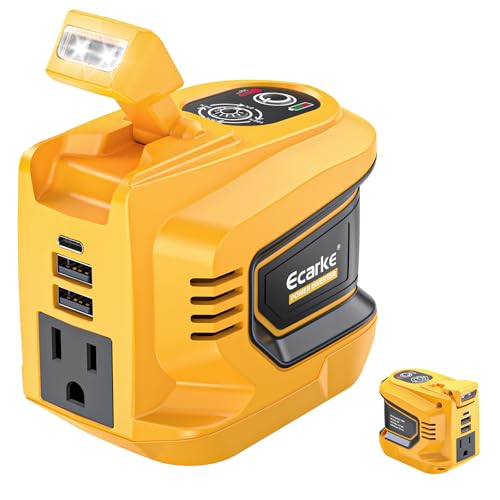
The Ecarke 220W is not a traditional power station, and that is exactly why it deserves a place in this roundup. If you already own DeWALT 20V batteries, this compact inverter gives you a quick way to turn that existing investment into portable AC power. For tool users, that is a clever approach because it reduces duplication. Instead of buying a second battery ecosystem, you can put the battery you already trust to work in a new way. The pocket-sized form factor also makes it appealing as a true grab-and-go accessory for the truck, tool bag, or emergency kit.
Its power ceiling is modest, so this is clearly aimed at light-duty use. Think chargers, phones, tablets, small lights, and a few low-wattage electronics rather than the tools themselves. The built-in work light adds useful value for roadside repairs or nighttime tasks, and the assortment of ports helps it punch above its size. The tradeoff is obvious, though. You need to already own a compatible DeWALT battery and charger, and the unit is only as useful as the battery capacity you have on hand. For DeWALT owners who mostly need a compact backup for accessories and light electronics, it is a smart, economical add-on. For everyone else, the system requirement makes it less compelling than a standalone station.
Pros
- Uses existing DeWALT 20V batteries, which adds convenience for current owners.
- Extremely compact and easy to carry.
- Helpful for light electronic charging on the go.
- Built-in LED work light is genuinely practical.
- Good safety protections for its size and class.
Cons
- Battery and charger are not included.
- Too limited for serious tool use.
- Only makes sense if you already own compatible DeWALT batteries.
This is best for DeWALT users who want a small utility inverter more than a full power station. It works well for travel, jobsite emergencies, and backup charging in a tool-heavy household. If you need actual high-output portable power, move up to a full station. But if your goal is to squeeze more versatility out of batteries you already own, this is a practical, low-cost solution.
To buy this product, click here.
4. Best Lightweight Mid-Size Option: Jackery Explorer 300

The Jackery Explorer 300 sits in a very useful middle lane. It is small enough to carry comfortably, but large enough to feel like a real tool companion rather than just an oversized power bank. For buyers who want something more capable than a pocket inverter but do not want the weight or cost of a 1000Wh-class station, that balance matters. At 7.5 pounds, it is one of the easiest models in this roundup to move from room to room or toss into a vehicle for a workday or weekend project.
Its 292Wh capacity will not run power-hungry equipment for long, but it is well suited to chargers, laptops, cameras, drones, lights, and other moderate loads. The pure sine wave output is a plus for sensitive electronics, and the LiFePO4 battery gives it a better longevity story than many older compact stations. Buyers who care about durability will appreciate that. The solar charging option is also attractive for people who work away from reliable grid power. The drawback is simple: it is not built for large tools or long runtime. It earns its place by being portable, dependable, and easy to live with. For many households, that is exactly the right combination.
Pros
- Very light and easy to carry.
- Good fit for electronics, chargers, and small accessories.
- LiFePO4 battery improves long-term durability.
- Pure sine wave AC output is safer for sensitive devices.
- Works well with solar charging for off-grid use.
Cons
- Not enough capacity for bigger power tools.
- Runtime is limited for anything beyond light-duty use.
- Still more expensive than some similarly sized budget options.
Buy this if portability matters more than brute strength. It is a sensible choice for hobbyists, travelers, and tool users who mainly need device charging and occasional backup power. If your list includes heavier workshop equipment, you should look higher up the power ladder. But for light, mobile use, the Explorer 300 remains one of the cleanest all-around choices.
To buy this product, click here.
5. Best Premium High-Output Choice: Anker SOLIX C1000 Gen 2
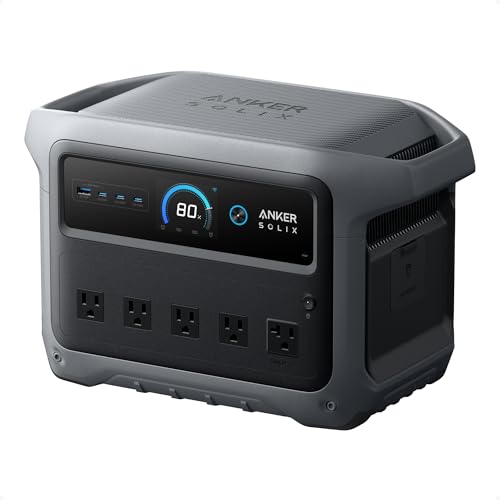
The Anker SOLIX C1000 Gen 2 is built for buyers who want serious performance without stepping into the truly bulky category. Its 2000W output, 1024Wh capacity, and 10-port design give it far more muscle than compact backup units, and the fast recharge claim is especially relevant for tool users. In practical terms, this means less waiting and more working. That matters whether you are dealing with a power interruption, a mobile workstation, or a remote setup where downtime is expensive. The UPS feature also makes it more appealing for people using laptops or other sensitive gear alongside tools.
This is one of the stronger picks for readers who want a premium station that can do a little of everything well. It is still portable enough to move around a house, workshop, or RV, but it has enough reserve to feel closer to a serious backup system. The app-controlled power management adds sophistication without becoming fussy. Its one real downside is that the price places it in a different category from budget buyers, and many casual users will never need this much output. But for people who do, the higher cost buys flexibility, fast turnaround, and a long service-life profile that should matter to anyone planning to keep the unit for years.
Pros
- High 2000W output handles demanding loads better than smaller units.
- Fast recharge time is a major advantage for frequent use.
- UPS backup support is useful for sensitive electronics and work setups.
- Compact relative to its power class.
- Multiple ports support mixed-device use.
- Long-life LiFePO4 design is a strong value over time.
Cons
- Higher upfront cost than midrange models.
- More capacity than many casual users need.
- App-based features may be unnecessary for simpler use cases.
This is a good fit for buyers who want premium performance and expect to use the station often. It suits home backup, remote work, RV life, and more demanding DIY applications. If you are comparing it to the Jackery Explorer 1000 v2, the Anker makes sense when raw output and port count matter most. If you are only powering a couple of lights and chargers, it is overkill. For serious users, though, it is one of the more compelling high-end options in the category.
To buy this product, click here.
6. Best Workshop Organizer: CCCEI Garage Power Tools Organizer Cart

Not every shopper searching for portable power stations for tools actually wants a battery pack. Some are really trying to solve a workshop organization problem, and the CCCEI Garage Power Tools Organizer Cart addresses that side of the equation directly. It combines storage with an integrated charging station, which is useful for anyone tired of piling drills, batteries, and chargers across a bench or shelf. For garages and small workshops, that can make a real difference in daily workflow. The cart format also makes it easy to move the setup where it is needed, which is more convenient than a fixed cabinet.
The tradeoff is that this is not a portable power station in the battery-backed sense. It is a power and storage solution, not an off-grid energy source. But as a shop accessory, it makes a lot of sense. If your “power station” needs are really about keeping cordless tool batteries organized and charged, this kind of product may be more useful than a traditional portable generator. The open storage layout helps with fast access, and the eight-outlet strip supports multiple chargers at once. Buyers who value tidiness, workflow, and less downtime between tool sessions should take a close look. If you need actual emergency backup power during outages, however, this should be viewed as a companion product, not a replacement for a true power station.
Pros
- Useful mix of storage and charging in one mobile cart.
- Can keep multiple tool batteries organized in one place.
- Wheels make it easier to move around a garage or workshop.
- Eight outlets add real convenience for rechargeable tools.
- Helps reduce bench clutter and charging chaos.
Cons
- Not a battery-powered portable power station.
- Best for storage and charging, not off-grid use.
- Assembly and footprint may not suit very small spaces.
Choose this if your main frustration is a messy tool area rather than a lack of electrical output. It is best for homeowners, hobbyists, and garage builders who want a central charging station for cordless tools. If you need backup electricity for a jobsite or outage, this is the wrong category. But if organization is the issue, it solves a very real one.
To buy this product, click here.
7. Best Wall-Mounted Charging Station: CCCEI Modular Power Tool Organizer Wall Mount

The CCCEI Modular Power Tool Organizer Wall Mount is a smart option for buyers who want tool charging without surrendering floor space. Wall-mounted storage is often the most efficient way to keep a garage or workshop under control, especially when battery chargers and drills tend to pile up on benches. This unit gives you a defined place for the most commonly used cordless tools, along with built-in outlet access that helps keep batteries ready to go. For compact workshops, that is a meaningful improvement in day-to-day use.
Compared with a rolling cart, this model is more space-efficient but less flexible. Once mounted, it becomes part of the wall setup, which is a plus if you want a permanent station and a minus if you prefer rearranging your workspace often. The steel construction and surge protection are reassuring details, and the modular design gives it a bit of room to grow if your tool collection expands. It is not portable power in the battery sense, but it absolutely belongs in a roundup for tool-focused power solutions because it addresses a common pain point: where to charge everything and how to keep it from spreading across the room. It is best for people who want a cleaner, more deliberate workshop layout.
Pros
- Saves bench and floor space by mounting to the wall.
- Eight outlets support multiple chargers at once.
- Good option for keeping frequently used cordless tools visible and organized.
- Modular layout helps adapt the setup over time.
- Heavy-gauge steel build feels better suited to a workshop environment.
Cons
- Requires permanent wall mounting.
- Not useful for mobile or off-grid power needs.
- Best for organization, not power delivery to large tools.
This makes the most sense for users who want a dedicated charging wall and can commit to a fixed setup. It is especially useful in garages, sheds, and home workshops where space is limited. If you need a portable battery source, skip it. If you want a cleaner tool station that keeps batteries and accessories in reach, it is an efficient solution.
To buy this product, click here.
8. Best Tiny Emergency Backup: HOWEASY Portable Power Station 88Wh

The HOWEASY 88Wh is another compact budget model, but it earns attention because it keeps the formula simple and practical. It is light, easy to carry, and small enough to live in a vehicle or emergency drawer without taking up much space. For readers who mainly want a backup source for lights, phones, cameras, fans, and other low-draw gear, that low-friction design is appealing. It also offers multiple recharging methods, which helps if you want something that can be topped up from the wall, car, or solar panel.
What keeps it from ranking higher is the same issue that affects most tiny stations in this category: it is not meant for serious tools. The 120W output is fine for small electronics, but anyone expecting to power heavier workshop gear will be disappointed. Still, there is a place for this kind of unit. If you want a dependable “just in case” power source for outages, camping, or vehicle use, the HOWEASY offers a straightforward option with enough outputs to be genuinely useful. It is especially appealing for buyers who are sensitive to size and weight more than wattage. That makes it a better emergency companion than a true tool station.
Pros
- Very light and easy to move around.
- Multiple output ports support several small devices at once.
- Good for emergency lighting and phone charging.
- Three charging methods add flexibility.
- Compact enough for cars, shelves, and emergency kits.
Cons
- Not suitable for most power tools.
- Small battery limits runtime quickly.
- Best for light-duty backup only.
Buy this if you want a no-drama compact backup unit for basic needs. It is best for homeowners, campers, and occasional users who value portability over output. If you need a station that can support anything beyond small electronics, this one is too limited. But for modest backup duty, it is a practical and easy-to-understand choice.
To buy this product, click here.
9. Best For EGO Battery Owners: EGO POWER+ Portable Power Station PST3040

The EGO POWER+ PST3040 is one of the more serious power options in this roundup, but it is aimed at a very specific audience. If you already own EGO 56V batteries, the platform makes immediate sense because the unit turns those batteries into a clean, quiet source of high-output AC power. That makes it attractive for buyers who want a gas-free alternative for home, yard, and outdoor use. The 2000W continuous output and 3000W peak rating put it in the conversation for more demanding applications than the smaller stations can handle.
As with any battery-platform product, the value depends heavily on what you already own. Because the battery and charger are not included, the entry cost can climb quickly. The upside is that EGO users can build a more cohesive system around a familiar battery line, and the weather-resistant construction with steel handles makes it feel like a serious piece of equipment. It is not the lightest or cheapest answer here, and it is less of a universal pick than the Jackery or Anker. But for the right buyer, it offers a strong blend of power and platform compatibility. If your workshop or outdoor setup already runs on EGO batteries, this is an especially logical upgrade.
Pros
- High output makes it suitable for demanding applications.
- Works with EGO 56V ARC Lithium batteries.
- Pure sine wave output is better for sensitive devices.
- Quiet, clean alternative to a gas generator.
- Weather-resistant construction adds peace of mind outdoors.
Cons
- Battery and charger must be purchased separately.
- Best value mainly for buyers already invested in EGO.
- More expensive than many smaller portable stations.
This is the one to consider if you want high output and already live in the EGO ecosystem. It is especially relevant for homeowners who want backup power without a gasoline generator, and for tool users who prefer battery compatibility over brand-agnostic flexibility. If you are starting from scratch, other options may be simpler and cheaper. But if you are already committed to EGO, this is a powerful and sensible extension of that system.
To buy this product, click here.
How We Chose
To build this roundup, the focus was on products that solve real tool-related power problems rather than simply chasing the biggest battery number. That meant weighing output, portability, recharge speed, battery chemistry, and whether a product made sense for actual tool users, not just casual campers. We also looked at how well each unit fits a distinct use case, from compact emergency backup to larger workshop and home backup applications.
Because the category includes both true portable power stations and tool-battery-powered inverters or charging organizers, it was important to separate the roles each product plays. A good choice for a cordless tool owner is not always the same thing as a good choice for someone who needs a clean backup source for a workbench. We gave priority to items that were practical, clearly differentiated, and honest about their limits. Products that could not be tied cleanly to the needs of tool users were left out.
Buying Guide
Choosing among the best portable power stations for tools starts with a simple question: what are you actually trying to power? If your goal is to charge batteries, run lights, and keep a laptop alive during a power outage, a smaller station may be enough. If you want to support higher-demand equipment or keep a broader range of devices operating at once, you need a larger inverter output and a battery capacity that can handle the load without dropping too quickly. Capacity helps with runtime, but wattage determines what the station can run at all. Both matter.
Recharge speed is another factor that gets overlooked. For tool users, a power station is often there to reduce downtime. A unit that charges quickly can be put back to work the same day, while a slow-recharging model can feel stuck in limbo between uses. Portability matters too. If the station is going into a workshop, truck, RV, or jobsite bag, the weight and handle design make a difference. The right choice is often the one that can actually follow you where you work.
Battery chemistry is worth paying attention to as well. LiFePO4 units tend to offer better cycle life, which is useful if you plan to use the station regularly rather than only during emergencies. Also consider the type of outlets and ports you need. Pure sine wave AC output is preferable for sensitive electronics, and USB-C power delivery is useful if you charge modern devices or accessories. If you are buying a product tied to a cordless tool brand, make sure you already own the compatible battery platform. Those products can be smart value plays, but only when the ecosystem works in your favor.
Best Portable Power Stations For Tools FAQ
What Size Portable Power Station Do I Need For Tools?
It depends on the tools. For charging batteries, lights, and phones, a compact 80Wh to 300Wh unit may be enough. For heavier work, such as powering larger tools or handling multiple devices at once, a 1000Wh-class station or higher is a more realistic choice. Always check both continuous wattage and surge wattage, not just capacity.
Can A Portable Power Station Run Power Tools?
Some can, but not all. Small stations are usually better for charging tool batteries and running accessories. If you want to run actual tools directly, you need enough wattage for the tool’s startup surge and ongoing draw. High-demand tools can overwhelm compact models quickly.
Is LiFePO4 Better For A Tool Power Station?
For most buyers, yes. LiFePO4 batteries usually offer better longevity and are better suited to frequent cycling. That makes them a strong choice for workshop users, DIYers, and anyone who expects regular use instead of occasional emergency-only operation.
Do I Need Pure Sine Wave Output?
If you plan to power sensitive electronics, chargers, or laptops, pure sine wave output is the safer, cleaner option. It is also a good idea if you want a more versatile station overall. For very basic gear, it may not be essential, but it is generally preferable.
Are Compact Inverters Worth Considering?
Yes, if you already own compatible cordless tool batteries. Products like the Ecarke inverter and Azocek-style units can be a smart way to turn existing batteries into portable AC power. They are not a replacement for a true power station, but they can be very practical for light-duty use and emergencies.
What Matters More, Capacity Or Wattage?
Both matter, but in different ways. Wattage tells you what the station can power. Capacity tells you how long it can do it. If the wattage is too low, the station will not run the tool at all. If the capacity is too small, it will run out of power too fast. For tool buyers, starting with wattage is usually the better approach.
Can A Portable Power Station Replace A Gas Generator?
Not completely. A portable power station is quieter, cleaner, and easier to use indoors or in shared spaces, but it does not match a gas generator for long-duration, high-wattage output. For many homeowners and tool users, though, it is the better day-to-day choice because it is simpler and more convenient.
Final Verdict
The best all-around choice in this roundup is the Jackery Explorer 1000 v2. It combines strong output, a practical battery size, fast charging, and a portable form factor in a way that makes sense for both tool users and general backup buyers. That balance is hard to beat. If you want more power and a more premium feature set, the Anker SOLIX C1000 Gen 2 is the strongest high-output alternative, while the EGO POWER+ PST3040 is the right call for buyers already committed to the EGO battery ecosystem. On the budget end, the MARBERO 88Wh and HOWEASY 88Wh are best treated as compact emergency helpers, not serious tool runners.
The most important buying advice is to match the product to the way you actually work. If you need a portable station for chargers, lights, and occasional electronics, smaller units can be perfectly sensible. If you want something that can support a broader range of tools, prioritize output, battery chemistry, and recharge speed before anything else. And if your real problem is workshop organization rather than portable electricity, a charging cart or wall-mounted rack may solve the issue better than a battery station at all. The right choice is the one that fits your tools, your space, and your routine without forcing you to compromise where it matters most.
Leave a Reply